
A long-standing customer may look great on paper. They’ve bought from you every month for years, the relationship feels solid, and nobody’s flagged a problem.
Then, out of nowhere, their spend drops off completely, and you’re left wondering what happened.
This is one of the most common — and most expensive — blind spots in manufacturing sales. The warning signs are there, but they weren’t visible to the salesperson who needed to see them.
Between ERP systems, invoicing platforms, and years of transactional history, most manufacturing businesses have more information than they know what to do with. But almost none of it reaches the sales team.
At a Glance
ERP systems sit at the centre of manufacturing businesses — it’s the operational nucleus that keeps orders, invoices, and stock moving. But pulling every scrap of available data into one place doesn’t create clarity. It just adds more noise, so salespeople end up overwhelmed instead of informed.
A good salesperson is a relationship builder — they’re agile, creative, quick on their feet. What they need is the same precision the back office applies to orders and service, brought to the front office. In other words, a small, sharp slice of information that’s highly relevant to the customer they’re speaking to. They don’t have time to act like analysts, a role that was never part of their skill set.
Historically, sales teams have relied on a weekly orders report, a monthly finance report, or a spreadsheet forecast built partly on gut feel — and by the time that data has been pulled, checked, and presented, it’s already out of date. A sales director could be looking at information that’s a month old, and by then, a customer may have shifted volume to a competitor without anyone noticing.
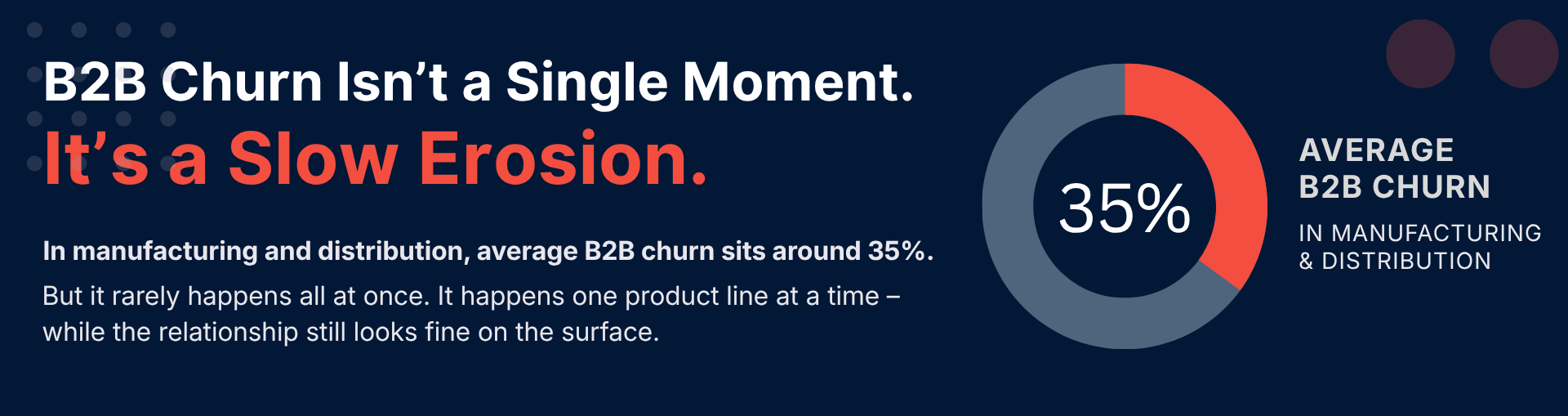
This is part of the reason churn is so difficult to spot in manufacturing and distribution. Average B2B churn in the sector sits at around 35% — among the highest of any industry. Customers shift volume one product line at a time, while the relationship on the surface stays perfectly cordial. Without a dramatic conversation to alert the rep or timely insights, the slow erosion of the relationship only becomes obvious when it’s too late.
Churn isn’t the only revenue being left on the table without sales intelligence. Winning net-new business takes months, sometimes years — the bigger opportunity, more often than not, sits with the customers manufacturers already have.
But cross-sell in manufacturing isn’t always intuitive. When a business sells a catalogue with tens or hundreds of thousands of SKUs, working out what an individual account is missing by hand is virtually impossible.
Even with fairly basic customer segmentation — by geography, sector, or account type — it’s possible to look at similar customers and see what their typical basket of products looks like. That comparison can turn an unmanageable list of thousands of products into two or three realistic recommendations for a specific account.
The same applies to early warning signs like a shrinking average order value, a product that’s stopped being ordered, or a margin slipped from 22% to 19%. These might be invisible to a rep looking at raw numbers, but obvious once flagged — and a chance for a rep to pick up the phone before business is lost.
Let the salesperson use their knowledge of the account history and the relationship they’ve built, and use data and AI to surface patterns a person would struggle to spot at speed, like the early warning signs above.
Picture the same salesperson before and after having these key, targeted insights. Before, they’re piecing together context from memory, a monthly report, and whatever’s in their inbox. With AI and data — and an ERP and CRM connection — they get a short, focused briefing before the meeting that includes which products have dropped off, whether there’s an unresolved invoice or credit issue, whether there’s been a recent complaint, or where spend has shifted.
A salesperson’s ability to grow an account is directly tied to how well they understand it. Pitching a new product without knowing the customer already has a problem with an existing one undermines trust fast. Walking in already aware of the issue changes the conversation entirely and shows the customer their supplier is paying attention.
The mechanics are simpler than most manufacturers expect, and they work in both directions.
A plugin connects SugarAI to the ERP, for example Sage, and syncs the core account data: companies, contacts, and enquiries. It also syncs product and stock levels, so a salesperson quoting a customer in the CRM is working from real-time availability and the correct price for that account. Invoices flow into the CRM too, so the sales team can see whether a customer is paid up, what their credit terms are, and whether an account is on hold without ever logging into the ERP.
Data flows back the other way as well. Once a quote is accepted in the CRM, it’s pushed into the ERP as a sales order, ready for dispatch or invoicing. Even something as simple as an updated phone number or address gets synced back, so the two systems never drift out of step. The ERP remains the master system with the CRM adding visibility and intelligence on top, like Sugar Predict, which draws on the invoice history, product data, and whatever customer segmentation exists, and turns it into the prompts, alerts, and recommendations described above.
Connecting ERP and CRM data doesn’t need to be a huge, drawn-out project — and it shouldn’t try to replicate the entire ERP inside the CRM either. Bringing across twenty years of transactional history a salesperson will never use adds bloat without value.
There are two distinct layers to get right:
Our advice? Start small and move fast. Rather than starting from scratch, we bring templates shaped by what’s worked across more than 2,000 manufacturing and distribution customers, and build from there based on what matters most — win rate, margin, or wallet share — to deliver something useful quickly.
Q: How long does it take to connect an ERP to a CRM?
For platforms like Sage and Infor, Provident CRM’s integrations can be live within days, not months. The plugin installs directly into SugarAI, and functionality is switched on through toggles rather than custom development to keep the timeline short.
Q: Will connecting our ERP mean duplicating everything into the CRM?
No — and it shouldn’t. The aim isn’t to replicate the ERP database inside the CRM. Instead, the goal is to bring across the specific signals a sales team can act on, such as invoice status, stock levels, and changes in ordering patterns, while the ERP remains the master system for core data.
Q: Will sales teams need to learn new reporting or analytics skills to use this?
No. The whole point is to remove that barrier rather than add to it. Instead of asking salespeople to interpret reports or run analysis themselves, the system surfaces alerts and recommendations directly — flagging, for example, a dropped product or a shift in margin — so the salesperson can act on it without needing analytical skills they were never expected to have.
If your ERP and CRM aren’t talking to each other yet, the best place to start is a conversation about what matters most to your business right now. Get in touch with Provident CRM for a free data gap analysis, and to talk through what connecting your systems could look like for your team.