


The Difference Between Owning a CRM and Getting Value From One
Choosing a CRM platform is no small investment. You’ve done the research. Sat through the demos. Compared the platforms, negotiated the contract, and gone live. And then, six months later, half the features are untouched, the team isn’t using it the way it was intended, and the business has moved on from the goals you built the whole implementation around.
A CRM is only as valuable as the support, guidance, and expertise wrapped around it. The platform is just the starting point.
That’s something Provident CRM has believed for over 20 years, and it’s why Customer Success isn’t just a department here, it’s a company-wide commitment. We sat down with Emma, one of our Customer Success Managers and a firm favourite among the customers she works with, to talk about what Customer Success actually means, how a strong partnership changes what’s possible with SugarAI, and why the support you have around your CRM matters just as much as the platform itself. With nearly a decade of experience in the SugarAI ecosystem, Emma has seen it all – the transformations, the near-churns, and the moments where the right question at the right time changed everything.
At a Glance
- Most CRM value is lost after go-live: the platform gets implemented, then quietly drifts out of step with the business.
- Customer Success is proactive, not reactive: the job is keeping your CRM delivering value as your goals change, not just fixing what breaks.
- The difference between owning a CRM and getting value from one usually comes down to the guidance around it, not the software itself.
- A named expert who knows your system means answers instead of ticket queues – plus a second opinion before you build something you’ll later unpick.
- SugarAI’s AI features (in-platform chatbot, prompt cards, AI Insights) only pay off if someone helps you apply them to how your business works.
What Customer Success actually is – and what it isn’t
Customer Success is one of the most misunderstood functions in the software industry. It’s often conflated with customer support, but the two are fundamentally different.
“Customer support is reactive. You go to them when something isn’t working. Customer Success is proactive. It’s about building a relationship so that customers feel they can trust their supplier to act in their best interests.”
– Emma, Customer Success Manager, Provident CRM
In practice, that means regular cadence meetings, quarterly reviews, and a constant focus on whether the platform is still doing what the business needs it to do. Because a business’s goals in year one are rarely the same as its goals in year three, and a CRM that doesn’t evolve with the business stops delivering value.
An answer, not a place in the queue
When something needs sorting, the last thing you want is to log a ticket and wait while it’s routed between departments. With a support package you have one named person who already knows your setup and who has the rest of Provident behind them when a question needs technical, project or product input. “The way I explain it to customers is: I essentially work for you, but from inside Provident. You come to me, and I find you the answer,” Emma says.
So you’re never explaining your system from scratch or chasing a queue. You raise it once, with someone who understands both the platform and your business, and it gets to the right person quickly.
Your CRM should grow with your business
One of the most common misconceptions about CRM is that implementation is a finish line. In reality, it’s a starting point.
Sometimes a CRM quietly stops being used — not because the platform failed, but because nobody was there to keep pushing it forward. Emma recalls one customer whose system was underutilised, running on just two active users, and close to being switched off entirely. Rather than treating it as a lost cause, Emma sat down with them to understand what had changed. And what had changed was the business itself, not the platform. Their requirements had evolved, and the system simply needed to evolve with them.
Working together, they reshaped how the platform was being used to fit where the business actually was. Within weeks, case-processing time dropped by around 30% and active users grew from two to nine.
Their Commercial Manager put it simply: “We save so much time. And time is money.” Their Account Manager added: “Now we’ve got everything documented in one place, the visibility and speed of processing cases is much improved.”
The difference between a CRM that’s almost switched off and one the whole business runs on isn’t always the platform. More often, it’s the partnership around it.
What a Support Package actually gets you
Without a support or advantage package, help defaults to generic portal access: log a ticket, wait. A package changes what you can actually do with the platform. Emma calls it having “your own personal CRM therapist on the other end of the phone”.
Here’s what that means when you’re trying to get more out of a system you already own.
1. Build the thing you’ve been meaning to build. Most under-used CRMs aren’t broken; they just never got configured around how the business works now. Want a new workflow, a cleaner process, a report you can actually trust? Your CSM works through it with you, from mapping the requirements to building it properly inside the platform.
2. A second opinion before you commit. Even experienced users benefit from someone to sense-check a direction and tell you honestly when it’s the wrong one. Every recommendation is backed by 20+ years across hundreds of implementations, so if a business like yours has tried it, chances are we already know how it played out.
3. Cover for when something goes wrong. At some point, something will. A support contract means you’re not navigating it alone. As Emma puts it: you wouldn’t drive without insurance. Your CRM shouldn’t be any different.
The role of the human – even in the age of AI
For all the promise of AI in CRM, Emma is clear about where the technology still falls short, and where human expertise remains irreplaceable.
AI is brilliant at summarising and consolidating information, but it can’t build a relationship, draw on experience from similar businesses in your industry, or tell you whether the process you’re planning will cause problems two years from now. That kind of guidance only comes from a partner who knows both the platform and your business well enough to give it honestly. The human element isn’t going away. It’s just becoming more consultative.
That said, the AI capabilities coming to SugarAI are exciting, and the right partner will help you make the most of them.
Here’s what’s coming:
- An AI chatbot that lets users query CRM data conversationally – ask for a report, get the report, no product expertise needed
- AI-powered prompt cards to help sellers prioritise their day, surfacing the opportunities most likely to close and flagging meetings that need preparation
- AI Insights (available now) – real-time account health summaries covering growth potential, risks, and blockers, without having to dig through an account’s history
Is your CRM working as hard as it could be?
New features and AI capabilities are only valuable if you know they exist – and know how to implement them in a way that actually makes sense for your business. For many organisations, that’s where the gap is. Not in the platform, but in the visibility and guidance around it.
It’s the same gap that shows up elsewhere too. Emma’s test for whether a business is truly maximising their CRM investment is simple: is it your single source of truth?
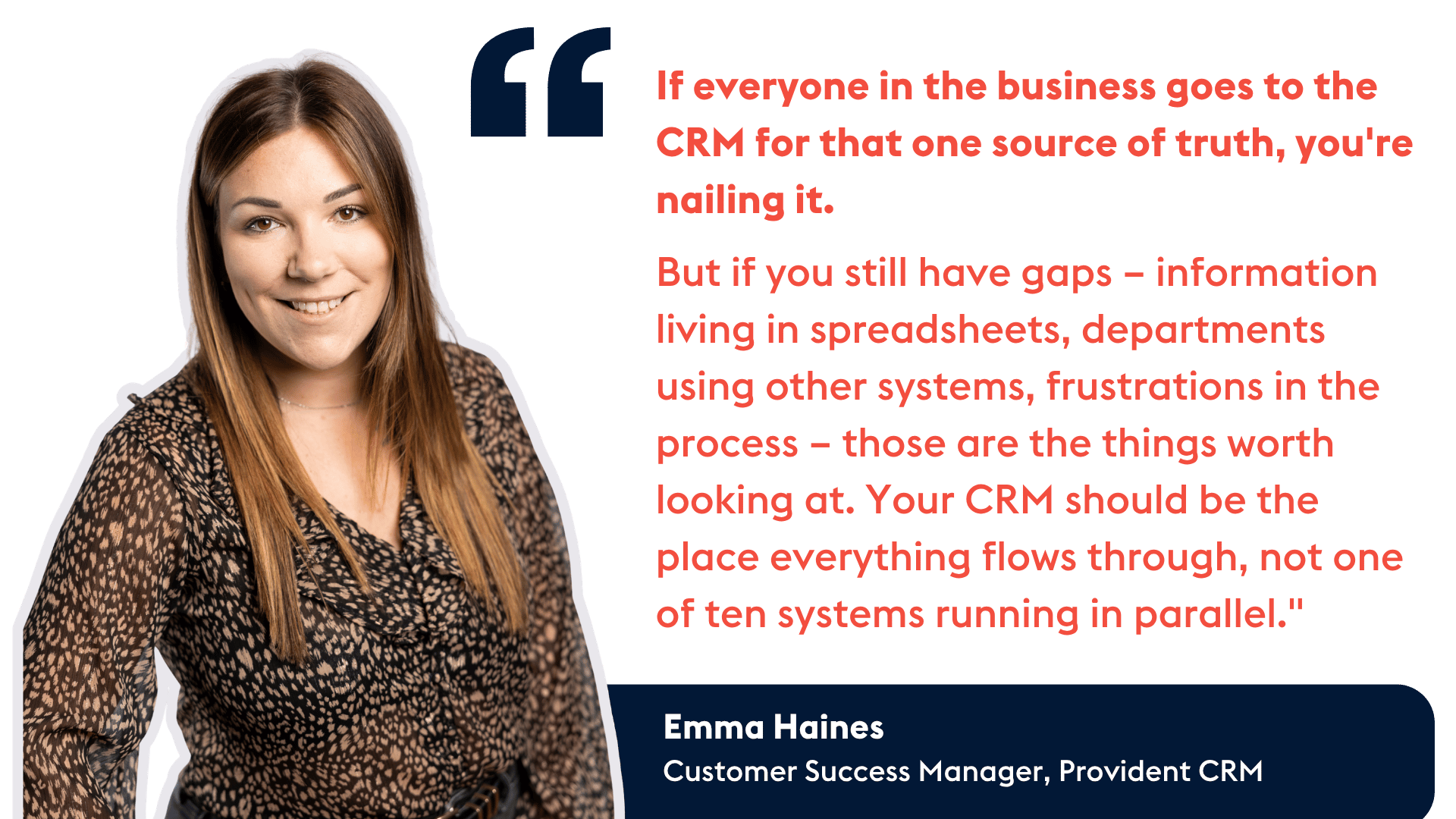
If the answer is no (or not yet), that’s not a reason to replace the platform. It’s a reason to have a conversation with someone who can help you get there.
FAQ
Q: What is the difference between Customer Success and Customer Support?
Customer Support is reactive – it fixes what’s broken. Customer Success is proactive – it’s an ongoing relationship focused on making sure your CRM keeps delivering value as your business evolves.
Q:What does a Provident CRM support package include?
Direct access to a named Customer Success Manager and the wider support team via phone and screen share. Hands-on help with issues, new processes, and strategic decisions, backed by 20+ years of expertise.
Q: Can SugarAI integrate with other systems like ERPs or finance packages?
Yes. SugarAI’s open source architecture makes it highly flexible and straightforward to connect with third-party systems. Provident CRM has built purpose-built integrations for a range of industries, including a Sage integration designed for manufacturing and distribution businesses.
Q:How do I know if my CRM is delivering value?
Ask whether it’s your single source of truth. If teams are still using spreadsheets, juggling multiple systems, or struggling to get a complete picture of customer activity, there’s likely unrealised value in the platform worth exploring.
Ready to get more from your CRM?
Whether you’re an existing SugarAI customer wondering if you’re getting full value, or a business evaluating CRM partners for the first time, Provident CRM’s Customer Success team is here to help.
Get in touch to find out what the right support package looks like for your business.