


One Platform, One Customer Record: How monday.com Keeps Every Team in Sync
When a customer moves between teams that each run on their own tools, they often end up telling the same story three or four times to different people in the same company. From their side, it doesn’t feel like they’re dealing with one business — it feels like they’re dealing with several.
In many cases like this, customer records are copied and pasted between tools, so handoffs require retyping information that’s already been captured somewhere else.
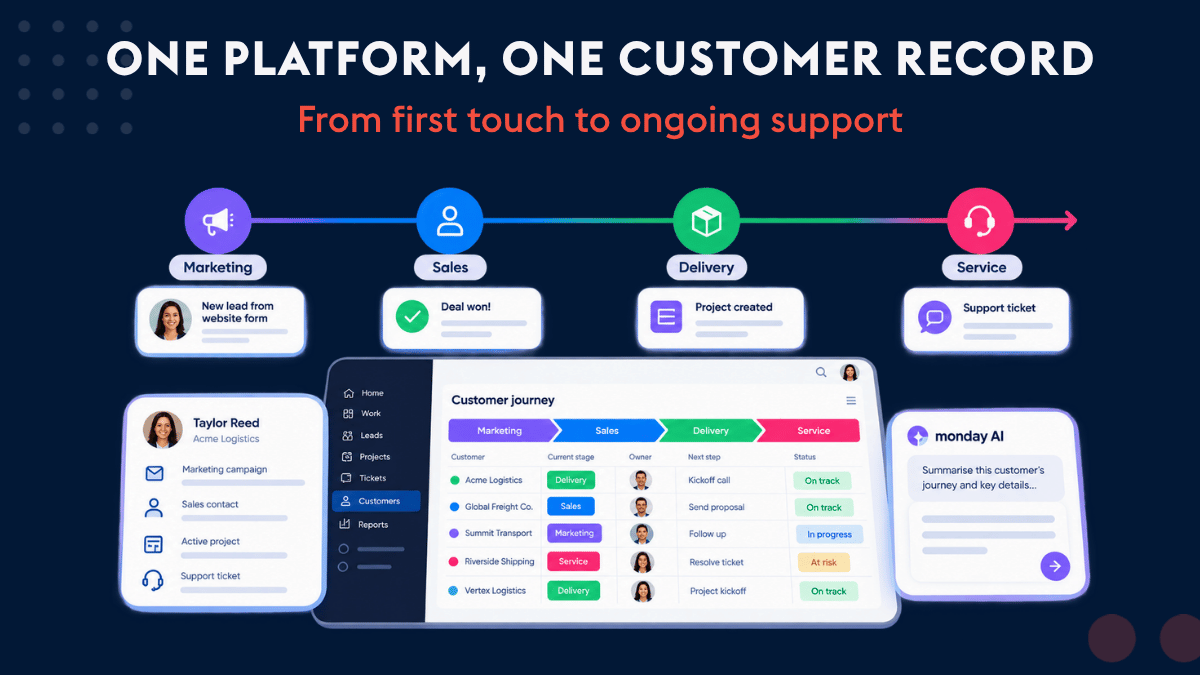
monday.com’s AI work platform brings marketing, sales, delivery, and service onto one platform, so the same customer record follows each customer from their first marketing touchpoint to their latest service ticket.
At a Glance
- Every handoff between disconnected tools is a chance to lose context, from who the decision maker is to what was promised at kickoff.
- When every team works on one platform, nobody has to re-enter data. The same customer record follows the customer the whole way through.
- Sidekick, monday.com’s AI assistant, saves teams from digging for information and can draft follow-up emails and handover summaries.
What happens when a customer moves between disconnected tools?
A customer journey crosses several teams, and often several systems. Marketing runs a campaign in one tool where someone fills in a form and becomes a lead. Then, someone in sales retypes that lead into a CRM. When the deal closes, it becomes a project in a different system altogether, and the delivery team is left trying to work out what was actually sold.
At every one of those handoffs, something can get dropped. It might be a note from a sales call, or who the decision-maker is, or a small promise made at kickoff that nobody documented properly.
Each team feels the strain differently:
- Marketing can’t see what happened after the click. They know how many people opened an email, but not which of them became customers, so they’re left guessing at what worked and what didn’t.
- Sales gets buried in admin. Reps are rekeying data, chasing information, and filling in handover forms. Weeks later, they’re getting messages from delivery asking, “What did you agree with the customer?”
- Delivery starts without full visibility. The context they need is sitting in someone else’s inbox, on a notepad, or in someone’s head. The first couple of weeks of a project ends in chasing people instead of getting the customer live.
See a connected customer journey
We’re currently working with a mid-sized logistics company that was running seven tools across its teams.
Their sales team closed deals by emailing the details over to onboarding. Projects usually started a week or two late, simply because people were chasing information and trying to piece together what sales had agreed.
Once we brought in monday.com, the handover happened when a deal was marked as won. An automation created the project straight away, and all the key details were already there because they were mandatory. Kickoff now happens within a couple of days instead of a couple of weeks. If you want to see how to make key fields required in your own boards, we’ve covered it in our guide to column validation.
They no longer spent their mornings chasing people for information — they had all of the details they needed.
What is the monday AI work platform?
Many people still think of monday.com as a project board, but it’s now the one place your whole customer journey lives. From the first campaign someone receives, to becoming a lead, to the deal closing, to a live project and on to service tickets, it uses the same record the whole way through.
The AI is built into the base layer of the platform, so it works from the same customer record your teams do. Because everything is in one place, the AI has the full picture to work from. Instead of hunting for information across different systems, people can simply ask for it.
The biggest change is a simple one: nobody has to re-enter anything. The information follows the customer as they move through the business.
- Marketing can see each lead alongside the campaigns they’ve received and how they engaged, without exporting lists or cross-checking the dreaded spreadsheets. They can also follow campaigns through to closed deals, rather than stopping at open rates.
- Sales and delivery don’t have to wait for handover documents. They can see what was sold, who the contacts are, what was agreed and any notes from sales calls.
- Leadership gets one view across everything, rather than pulling reports from different tools and trying to make the numbers match up.
The connected customer journey in action
Amy McLaughlin, Customer Success Manager at Provident CRM, walks through one customer’s journey across the monday AI work platform.
In the demo, a head of operations at a logistics company arrives on the leads board. Marketing can see which campaigns she’s been sent, whether she opened them and what she’s interested in, which tells sales whether she’s warm. Once sales has spoken to her and qualified her, she becomes an opportunity. Her pain points, who was involved, and the decisions made all stay on her record.
When the deal is marked as won, an automation creates the project in the portfolio. From there, service tickets can be raised with her details already filled in.
For sales, the difference is significant. Without that context, a call might start with “I see you downloaded something. Can I help with that?” Now, reps can have a proper conversation about what the prospect is actually interested in. And unlike a standalone CRM, where sales loses sight of the customer once the deal is won, the whole journey stays visible from start to finish.
How does monday sidekick cut admin across the customer journey?
monday sidekick is the AI assistant on monday.com that sits across the entire platform and saves you from digging.
Think about how much time people spend clicking through boards, searching through emails, and pinging colleagues just to find out what’s going on with a customer. Because everything already lives on the platform, monday sidekick can pull it all together when you ask.
It doesn’t just find information, either. It can draft a follow-up email after a call, write a handover summary when a deal closes, or pull together a quick update on where a project is and whether there are any delays. Sidekick takes on the admin that eats up the day, giving people time back to talk to customers.
Here are a few prompt examples by team:
- Marketing: “Which leads have opened our last two campaigns but haven’t been contacted yet?” Depending on the numbers involved, that list could otherwise take an afternoon to pull together.
- Sales: “Summarise everything we know about this lead, including which campaigns they’ve been sent and which they’ve engaged with.” This gives reps a briefing before a call, in seconds.
- Delivery: “Give me a handover summary of what was agreed in the last deal.” This replaces the handover document someone would normally have to write.
Nobody needs to build a report or chase a colleague. They just ask sidekick.
How should you start connecting your teams?
Adopting a platform that covers marketing, sales and delivery can look like a massive project – nobody wants to rip out systems they’ve used for years and retrain the whole company in one go.
But you don’t have to. Most of our customers start with one or two teams, get them working comfortably, then connect the next piece when they’re ready. Moving in smaller steps means each team gets set up properly.
The other concern we hear often is adoption. But when the platform is built around how a team actually works, using their language and processes, it makes their day easier, and they don’t drift back to spreadsheets.
Before you think about the technology, map where your handoffs happen and where things get lost. Sit down with each team and ask: “What do you wish you got when a customer lands with you?” The answers are usually very telling.
Then pick the handoff causing the most pain. For many businesses, that’s marketing to sales, or sales to delivery. Get it working well, then build out from there. It’s much easier to bring the next team on board once they’ve seen it working for someone else.
Frequently Asked Questions
Q: Is monday.com just a project management tool?
While many teams first used it to track tasks, the monday AI work platform now covers the full customer journey, from campaigns and leads through to projects and service tickets, with the same record throughout.
Q: Do we need to move every team onto monday.com at once?
Most customers start with one or two teams, get them working comfortably, and connect the next team when they’re ready.
Q: How does monday.com connect the customer journey?
By keeping one customer record that follows each customer from their first campaign to lead, deal, project and service tickets. Automations move them between stages, such as creating a project when a deal is won, so nobody has to re-enter data. AI then works across all of it.
Get every team working from the same customer record
monday.com is easy to use, but if the foundations of the connected platform are wrong, they’re painful to fix later, and that’s usually where adoption falls. At Provident CRM, we know the common pitfalls, so we build around how each company actually works and we stay with you after go-live as your business changes.
Not sure where to start? Book a 30-minute call, and we will map your customer journey together, from the first campaign to service ticket, and pinpoint the handoff to fix first.
Posted on