


How UK & Irish Manufacturers Beat Silent Churn with Sage ERP and SugarAI

(Updated May 2026)
Eighteen months ago, we wrote about the growth challenges facing manufacturing, wholesale, and distribution businesses, and why AI was finally within reach for operators who had never fancied themselves tech companies. A lot has changed since. The software has become cheaper, the tools have improved, and every CFO has now sat through at least one pitch deck with “AI-powered” in the subtitle.
What hasn’t changed is the shape of the problem. If you make something, move something, or sell something through reps, the gap between what’s in your ERP system and what your sales team can actually see is still where the money leaks out. The phrase our commercial directors keep using when we dig into it is silent churn: customers who haven’t left, but who have quietly halved what they buy from you across product lines and over months, without anyone in sales spotting the drop.
This is the 2026 version of that piece. Same problem. Sharper answers.
AI is no longer new – so why should manufacturers care?
Back in 2024, the question was, “What is AI, and should we be doing something about it?” In 2026, it’s the opposite. The word is everywhere, it’s on every vendor slide, and most manufacturing, wholesale, and distribution operators we speak to are, quite rightly, a bit sick of it.
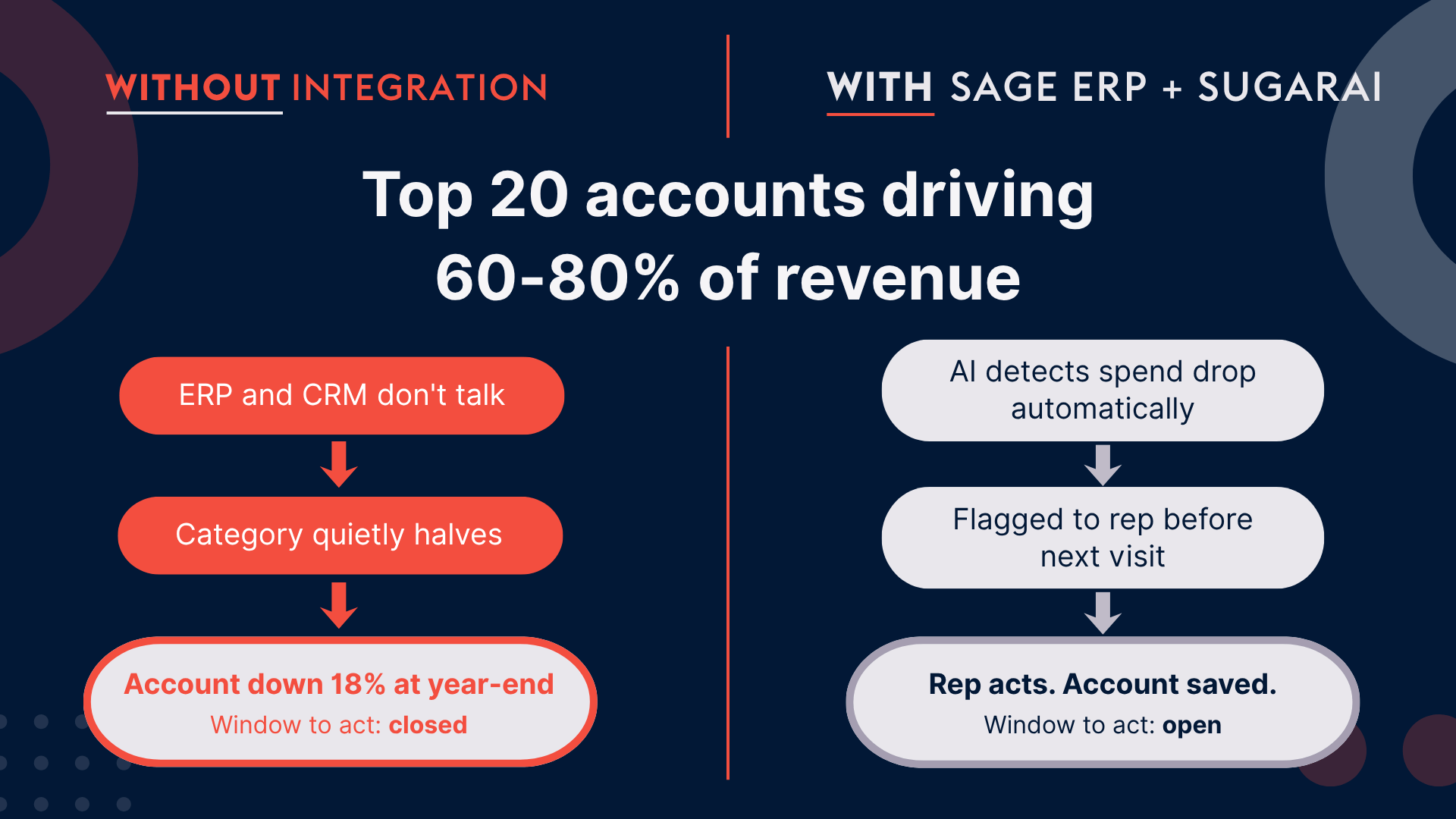
Picture this: your reps walk into their top 20 accounts each month. They know the relationship. They know the person. What they can’t see — because the data sits in the ERP and their CRM doesn’t talk to it — is that three of those accounts have quietly stopped buying one of your product lines over the last 90 days. A category has halved. A site has fallen away. Nobody has complained, nobody has left, and nobody on the sales side has flagged it because the data isn’t where reps work.
That’s silent churn. An AI layer stitched onto a connected ERP and CRM setup spots it automatically, on a rolling basis, and flags it to the rep before the next visit. That’s it. No chat interface, no copilots, no blog post about the future of work. Just a list in the CRM showing which customers have quietly reduced spend and on which lines. That is the AI use case for manufacturing businesses in 2026.
We wrote about four specific ways disconnected Sage ERP and CRM data leaks revenue in this piece. If you’re still on the fence about whether AI matters for your business, start there.
“If it isn’t broken, don’t fix it” – the most expensive sentence in manufacturing
The business is running. The ERP works. The reps have their spreadsheets. “If it isn’t broken, don’t fix it.”
If you’re running a manufacturing or distribution business that’s been trading for thirty years, the systems you’ve got have a kind of quiet respect built up around them. They did the job. They still do the job. Ripping anything out has a real cost: training, disruption, and the risk that something that worked on Tuesday doesn’t work on Wednesday.
But that sentence hides a question nobody in sales wants to ask out loud: how would we know if it was broken?
If your reps are reconstructing customer history from memory and whatever is in their own CRM notes, while the actual order history lives in the ERP and the two sides don’t talk, the business can be leaking revenue for six months before anyone notices. By the time the year-end numbers come in and the CFO flags that a top-20 account is down 18%, the rep has already missed the window to save it.
The “if it isn’t broken, don’t fix it” frame works perfectly well for machinery. It breaks down when it comes to commercial visibility, because commercial visibility doesn’t stop working loudly. It stops working silently. We covered the impact of that in a companion piece, The Hidden Cost of Disconnected Systems.
Saturated accounts and the silent-churn problem
Here’s the pattern we see in almost every business we audit. The top 20 accounts drive 60–80% of revenue. Growth is not going to come from net-new logos at that weighting — it’s going to come from the existing book. So the job of the sales team isn’t really prospecting. It’s spotting, account by account, which lines are growing, which are flat, and which have gone quiet.
That job is impossible without a connected view.
In practice, the phrase we hear from reps when we ride along on customer meetings is: “I’ll check with accounts.” That single sentence is the tell. It means the rep is sitting in front of the customer, doesn’t have the order history to hand, doesn’t know what the customer has quietly stopped buying, and has to leave the meeting, email the finance team, wait a day, and follow up. In the meantime, the customer conversation is about what the rep can see — not what actually matters.
When we connect ERP and CRM, two things change. Reps see live credit status, invoice history, and product-line trends on every account card before the meeting. And silent churn gets surfaced automatically, so the three accounts that have quietly stopped buying category X this quarter end up at the top of the rep’s next-action list instead of slipping under the radar for another six months.
We also handle the finance-side concerns separately: role-based visibility, audit trails, and compliant infrastructure.
“Every minute your team spends chasing data across disconnected systems is a minute lost on growth. Integrating Sage ERP with SugarAI doesn’t just tidy up your processes — it unlocks visibility, speed, and confidence across your entire organisation.”
– Gary Cullen, Chief Revenue Officer, Provident CRM

We’re offering a free gap analysis
A gap analysis is a 20-minute conversation where we ask the three or four questions that tell us where the ERP–CRM gap is quietly costing you revenue. At the end, you’ll have a one-page written picture of the gap, with an order-of-magnitude estimate of what closing it is worth. No deck, no pitch, and no obligation to do anything with us afterwards.
If the conversation points somewhere obvious, we’ll tell you what a unified Sage ERP + SugarAI setup would look like for your business, what it would cost, and what the timeline is for a working pilot. If it doesn’t, we’ll tell you that too — and send you on your way with the picture, which you can use however you like.
The only thing we ask is that you come to the call with one piece of honesty: how much of our top 20 is down year on year, and do we actually know?
If the answer is, “I’d have to pull a Sage report and cross-reference,” that’s the gap. That’s what we fix.