


From Chaos to Clarity: How AI is Changing CRM Data Management
There’s a conversation we have constantly with prospects. They come to us with a CRM that isn’t doing what it should, and when it’s not an obvious technology problem, it’s usually a data problem.
Messy contact records. Duplicates. Stale information sitting untouched for months. Fields used inconsistently across the team. The CRM’s there and the licence is getting paid, but the output is unreliable. And when sales leaders can’t trust what the system is showing them, they stop using it properly. The data gets worse. The cycle continues.
We’ve covered the fundamentals of CRM data hygiene before. The principles haven’t changed. But what has changed, in 2026, is how much of this work AI can do for you, and what that means for the businesses still doing it the hard way.
The problem hasn’t changed. The solution has.
On average, we know that B2B customers double their database every 12 to 18 months. The volume can quickly get out of hand. Less is more: making sure you’ve got only fresh, unified contact records is key.
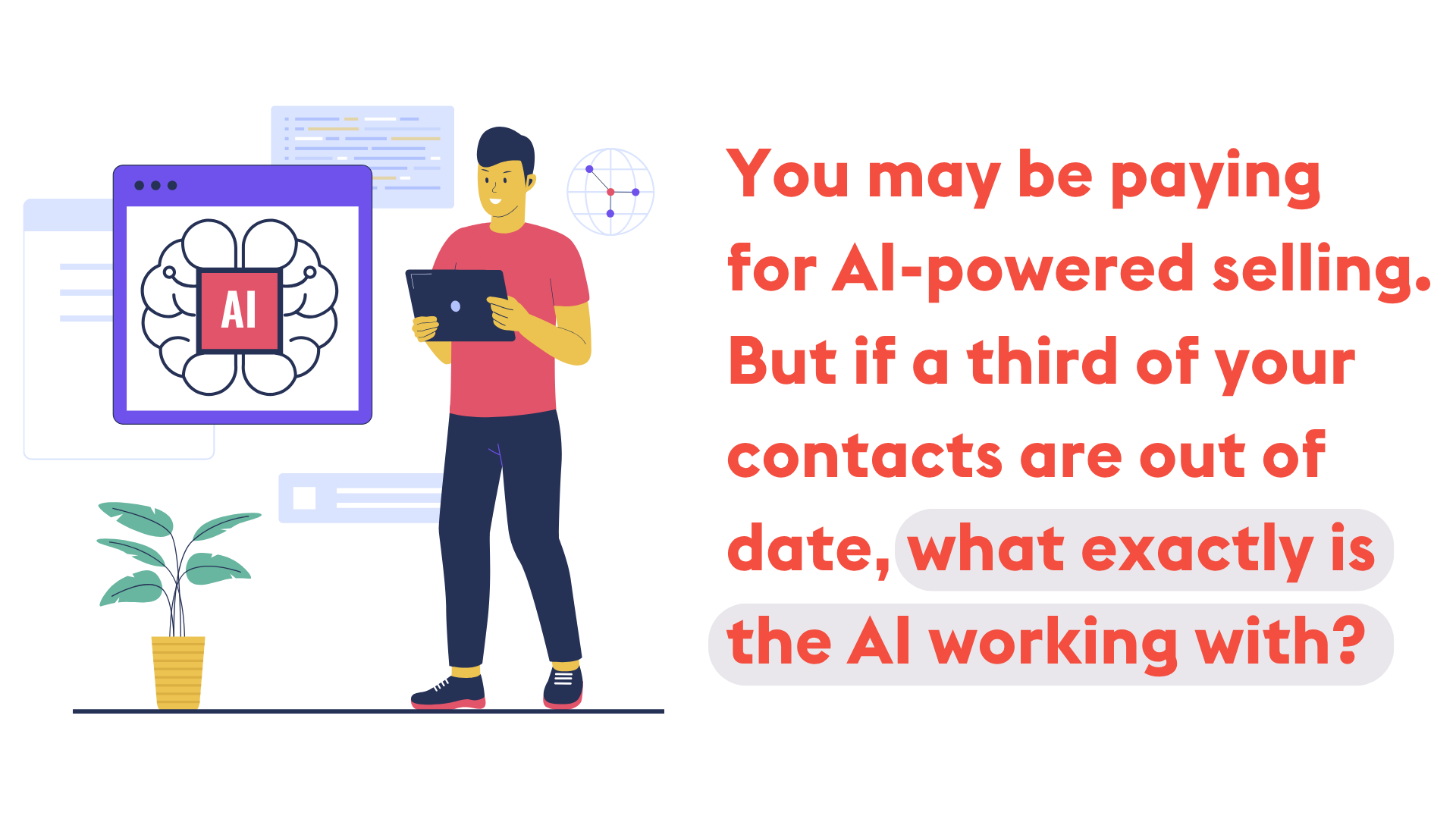
About 30% of company data becomes outdated each year, as people’s roles and contact details change. So if you’ve not interacted, it’s time to sweep away those cobwebs and make room in your CRM for more promising prospects.
What’s changed is that the manual effort required to fix this – the data audits, the duplicate checks, the field-by-field reconciliation – no longer has to fall on a person with a spreadsheet and a free afternoon. A recent survey found that 76% of data professionals still rely on spreadsheets as their primary cleaning tool. That number should be going down quickly.
What AI can actually do here
Smarter deduplication
Traditional duplicate checking matched records on exact fields. If someone signed up twice with slightly different versions of their name or email, you’d miss it.
AI uses probabilistic matching and fuzzy logic to identify records that likely represent the same person, even when the details don’t line up exactly — “J. O’Brien” and “John O’Brien” at the same company, different email domains. It scores similarity across multiple attributes at once and flags likely duplicates for review, rather than expecting a human to catch them manually or waiting for the CRM to miss them entirely.
Continuous data enrichment
This is where the shift is most significant. Previously, data enrichment was a periodic exercise: pull a list, send it to a third-party provider, get it back with updated fields, re-import. Slow, manual, and already out of date by the time it was done.
AI-powered enrichment tools now monitor your CRM records continuously, cross-referencing them against live data sources to pick up job changes, company restructures, updated contact details, and changes in buying behaviour — and push updates to records automatically. Your database can stay current without anyone actively managing it.
Filling the gaps intelligently
Incomplete records are one of the most common data quality issues we see. You’ve got a name and an email but no phone number, no company size, no LinkedIn. Getting reps to fill those in manually is a losing battle.
AI enrichment tools can identify missing values across your contact database and use pattern recognition and external data sources to fill them in — job titles, firmographics, verified email addresses, company information. The result is more complete records without the data entry burden falling on your sales team.
Standardisation across sources
If you’re pulling data in from multiple sources – lead forms, ERP systems, marketing platforms – inconsistent formats quietly undermine everything downstream. Dates that don’t match, company names entered differently, phone numbers in various formats. AI-driven standardisation learns the formats your CRM expects and applies them consistently as data flows in, catching the issues before they compound.
The catch: AI needs good foundations to work
Here’s the honest caveat, and it’s worth saying plainly. AI doesn’t fix an information gap — it amplifies it.
If your CRM is built on incomplete or poorly structured data, AI tools will work faster with worse inputs. If your sales team is logging minimal information, if your integration with your ERP isn’t live and accurate, if your pipeline stages don’t reflect your actual sales process — AI can’t manufacture the context that isn’t there.
This is something Trevor talks about when he works with prospects on their CRM setup: reps with happy ears, logging deals that feel good rather than deals that are real. A weighted forecast built on optimistic pipeline data isn’t more reliable because AI is running it. It’s faster, but it’s still wrong.
The fundamentals still matter. Clean data going in. Fields that reflect your actual process. Integrations that pull in the full picture — including the financial context sitting in your ERP that your sales team needs but can’t see. We wrote about this more in depth here.
AI can then take that solid foundation and do something genuinely powerful with it.
What this means for AI-powered CRM
The rebrand from SugarCRM to SugarAI wasn’t cosmetic. It reflects a real shift in what the platform is built to do: not just store what happened, but guide what should happen next. As their CEO put it, teams don’t need more dashboards — they need direction.
That kind of precision selling only works if the data behind it is trustworthy. AI that surfaces account risks, flags changes in buying behaviour, or recommends next-best actions is only as useful as the records it’s reading from. A contact who left that company eight months ago. An invoice that’s been sitting unpaid for weeks. A deal that’s been sitting in “proposal stage” for longer than anyone wants to admit.
The CRM is no longer just a system of record. But for it to be a system of intelligence, the records have to be right first.
Updated best practices for 2026
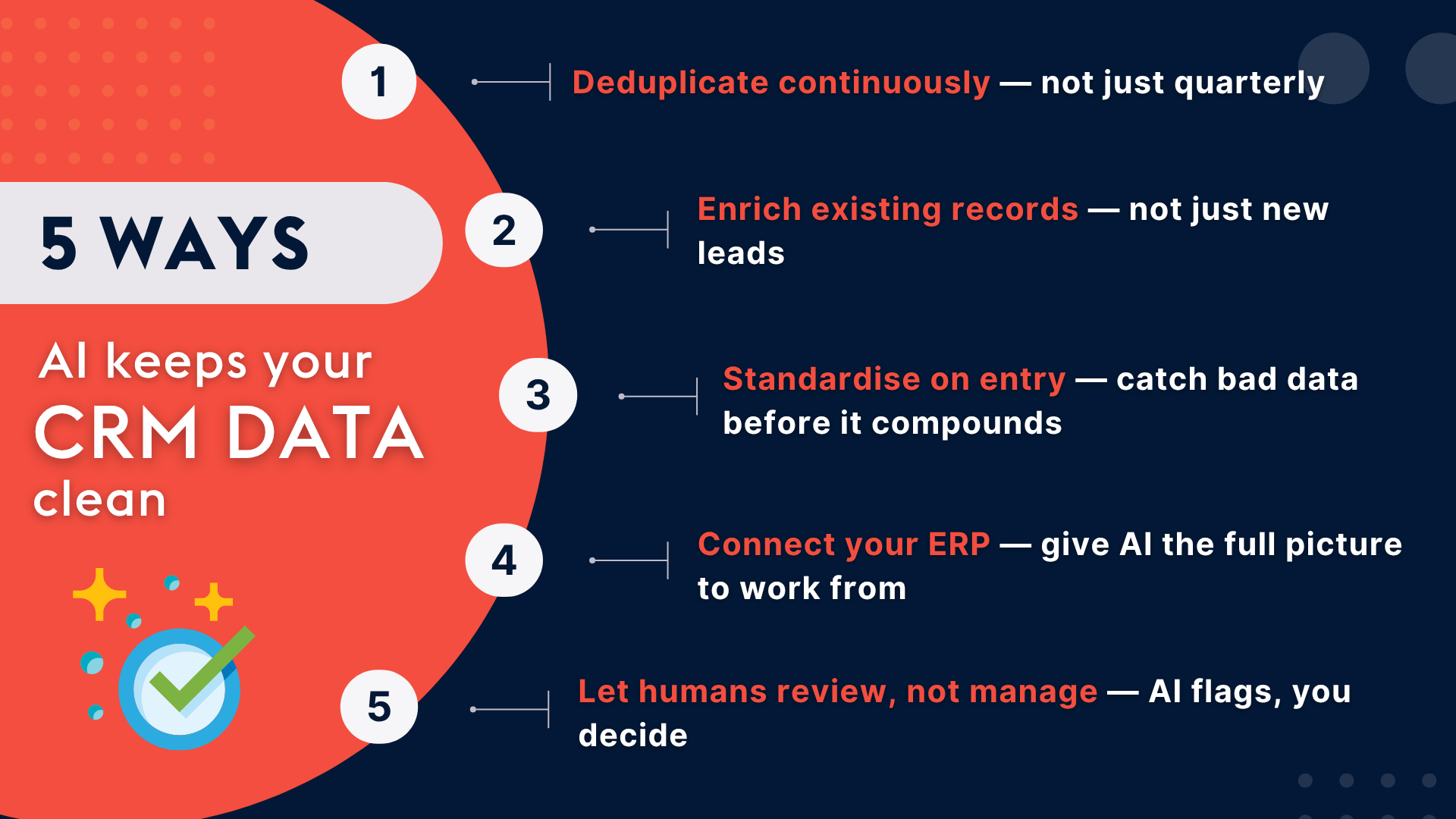
✓ Run an AI-assisted data audit before anything else
Before you invest in AI features or enrichment tools, understand what you’re working with. Most modern CRM platforms have built-in health dashboards that surface data quality issues across your records. Start there. Know what’s incomplete, what’s stale, what’s duplicated.
✓ Set deduplication on continuous, not occasional
The old habit of quarterly duplicate checks isn’t good enough when your database is growing. AI deduplication tools can run continuously, flagging likely matches for human review as they appear rather than letting them accumulate. If your CRM has built-in duplicate detection, make sure it’s configured and active.
✓ Automate enrichment for records, not just new leads
Most teams focus enrichment effort on inbound leads. The bigger win is often the existing database — contacts that are months or years old, with job titles and company information that’s no longer accurate. Scheduled enrichment runs can refresh those records automatically on a cadence that suits your business.
✓ Fix your integrations before you fix your data
If you’re planning to use AI-powered features for forecasting, account intelligence, or next-best-action guidance, your CRM needs the full picture. That usually means a live, accurate integration with your ERP — so your sales team can see order history, invoice status, and buying patterns in the same place they’re managing their pipeline. Get that right first.
✓ Don’t remove the human layer
AI flags, recommends, and automates. But it still needs human oversight for anything ambiguous. A probable duplicate that might actually be two different contacts at the same company. An enriched job title that doesn’t match what the rep knows from their last conversation. Build in review steps, particularly for records going into active campaigns or forecasting.
✓ Keep fields to a minimum — AI doesn’t change this
Reducing field bloat in your CRM remains as important as ever. Lean configurations drive better adoption, better data quality, and cleaner reporting. More fields don’t give AI more to work with — they just give it more noise.
Spring clean ready
At Provident CRM, we take time to understand your business, your processes and your teams’ ways of working. So when it’s time to roll out or refresh your CRM, it’ll be set up to enable sales, marketing and service to work together — not forcing awkward, time-consuming admin on your team, but letting them get on with the roles they’ve honed, better.
Whether you’re looking at a first implementation, a data migration, or getting more from a CRM that isn’t delivering what it should, the starting point is the same: get the data right. Then let AI do the rest.
Whatever the size of your business, it’s worth starting now. One of the most common conversations we have is with prospects who thought they were too small to have a CRM, then 6 to 12 months later they’re swamped in messy client data — and wish they could hit rewind.
Want to talk through your CRM needs?
Working with our team at Provident means that all you need clarity on is what you want, not how to get there — we’ll gladly take care of that. Feel free to reach out to us via the link below.
Posted on