


The Four-Week Blind Spot: Why Manufacturers and Distributors Find Out Too Late That a Customer Has Stopped Buying
Somewhere in your customer list there is an account that used to order every month and stopped six weeks ago.
Nobody has noticed. Not because your people are careless, but because nothing in your business is set up to notice. The order simply did not arrive, and an order that does not arrive makes no sound.
For most businesses that make products, or sell products other people make, this is the shape of revenue loss. It is not dramatic. There is no lost tender, no angry phone call, no competitor announcement. There is an absence, and absences are invisible until somebody goes looking.
At a Glance
- Manufacturers and distributors typically take 4–12 weeks to notice a regular customer has stopped ordering.
- With hundreds of customers and thousands of SKUs, one account’s decline hides behind another’s growth — total revenue looks fine while relationships quietly fail.
- Manual spreadsheet reporting is the biggest cause of the delay: it’s slow to produce, so it’s only done monthly.
- Account knowledge often lives in one salesperson’s head, not in a system — a risk when they leave.
- The fix: surface data you already have, in real time, to the person having the customer conversation.
How long is the gap?
Our team at Provident CRM has spent years selling into manufacturing, wholesale and distribution. When we ask customers how long it takes them to spot that an account has gone quiet, the answer is consistent and uncomfortable.
“It could have gone four, six, twelve weeks before someone noticed a customer had stopped buying – because one person found that in the spreadsheet. Whereas if there’s something that alerts the salesperson, everyone could know about that tomorrow.”
The difference between those numbers is not a reporting improvement. It is the difference between a conversation you can still win and a conversation you have already lost. A customer who stopped buying yesterday is a customer with a reason you can still address. A customer who stopped buying two months ago has already found somebody else, signed something, and moved on.
Why this hits manufacturing and distribution businesses harder
The structural reason is volume. A business with a handful of customers and a handful of products notices immediately when something changes. A builders merchant, a food and drink wholesaler or an industrial supplier is dealing with hundreds of customers and thousands of SKUs, and the month-to-month movement across that grid is enormous.
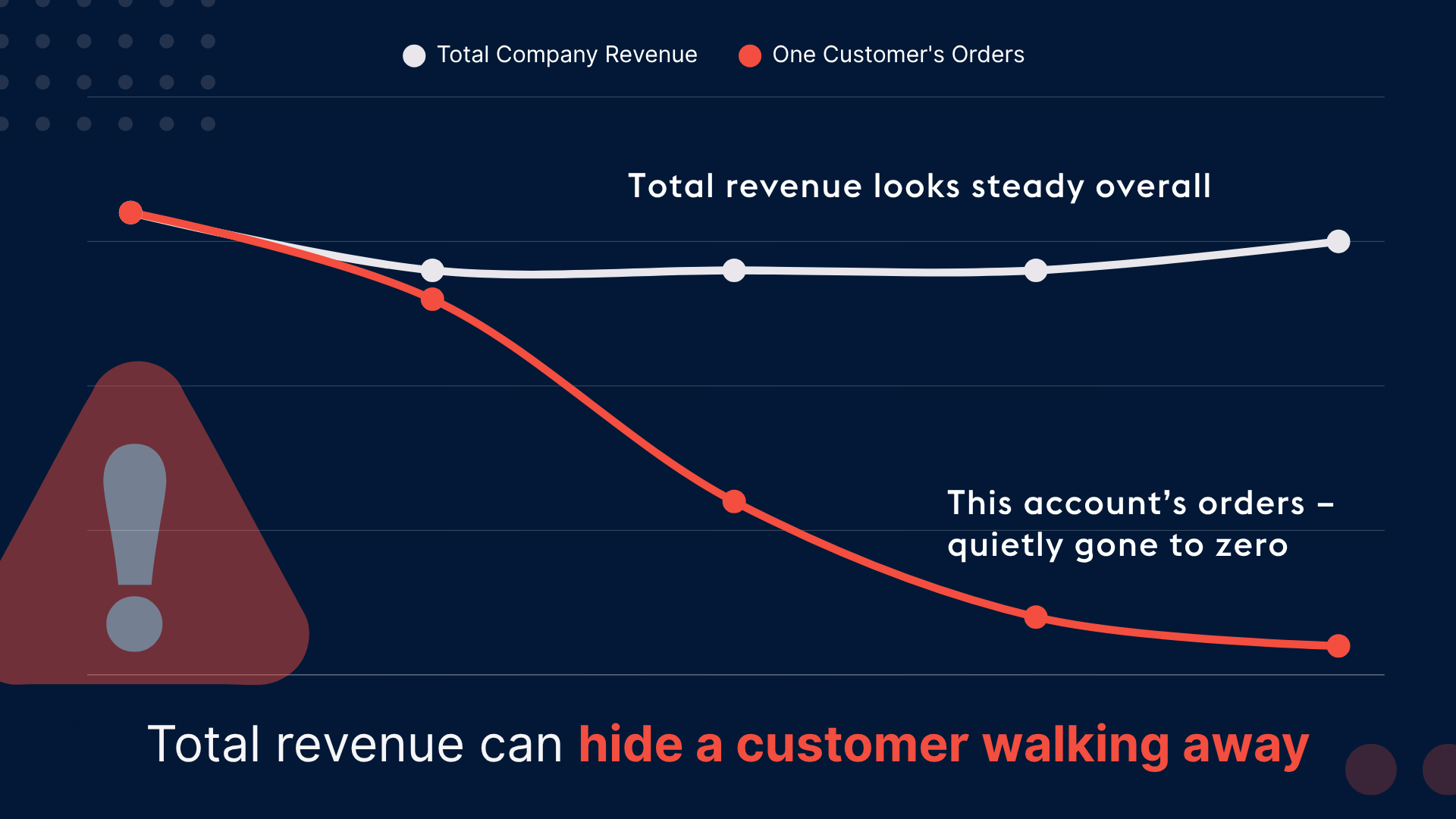
Which produces the most dangerous condition in this sector: the totals look fine.
“For whatever reason, one customer is spending more and another customer is spending less. So overall it looks like the picture is rosy. But as we start to take the layers of the onion away, we realise there are some underlying issues.”
Aggregate revenue is a poor smoke alarm. It nets out exactly the signal you needed to see. By the time a decline is large enough to show up in the monthly figure, it is not an early warning any more – it is a post-mortem.
We’ve written before about how this shows up as silent churn in manufacturing and distribution specifically — the same blind spot, seen through a different lens: ERP data that already contains the warning signs, sitting unused.
The bit that makes spreadsheets expensive
Almost every business in this position is running the same workaround. Somebody exports from the ERP, builds a sheet, and circulates it. It is free, it is familiar, and it is the single biggest reason the blind spot persists.
Free is the wrong word. The spreadsheet costs whatever the person building it would otherwise have been doing, every month, forever. And because it costs that much to produce, it gets produced monthly – which is precisely why the gap between reality and awareness is measured in weeks.
“The product itself is free, but the time you’re investing in it is dead time and needs ongoing maintenance. Collaboration on Excel is death.”
The knowledge that leaves when people do
There is a second blind spot sitting alongside the first, and it is arguably worse because it is not even recorded anywhere to be missed.
Your best salesperson knows which customers should be buying which products. Not from analysis, but from twenty years of standing in their yards. That understanding is real, valuable, and stored entirely in one head.
Which is fine, right up until that person retires, moves to a competitor, or you hire three new reps who need to reach their standard inside a year rather than inside a decade. In a sector where the workforce skews older and tenure runs long, this is not a hypothetical risk. It is a scheduled one.
Seven questions worth asking your own team
None of these requires software to answer. They require somebody to ask them out loud.
- If one of your top customers stopped ordering tomorrow, how many days would pass before somebody noticed?
- Who in the business could name five products a given customer should be buying and is not?
- Is that answer a person, or a system?
- How many hours a month go into producing the sales report — and how old is the data by the time anyone reads it?
- When a rep leaves, how much account knowledge leaves with them?
- Could you tell today whether a fall in sales of a product is a customer problem or a product problem?
- What percentage of this year’s revenue came from accounts you already had last year — and do you know that number, or are you estimating it?
If most of these land awkwardly, the issue is not effort or talent. It is that the information needed to answer them already exists inside the business, in the ERP, and nobody has put it in front of the people having the customer conversations.
What the fix actually looks like
It is worth being clear about what is not being proposed here. Not a transformation programme. Not a new ERP. Not asking a rep who has kept a paper order book for thirty years to become a data analyst.
The realistic target is narrower: get the transactional information you already own in front of the person who owns the conversation, before it happens, and have the system raise its hand when something changes. Gary Cullen, CRO of Provident CRM, frames it as the system watching continuously so the individual does not have to keep every edge pinned down.
That is a smaller problem than digital transformation, and unlike digital transformation, it has a definable finish line.
Want a clearer picture of your own customer data?
The accounts that go quiet are almost always visible in your data. They’re just not in front of anyone. In a free Data Gap Analysis, we’ll look at where your business could be missing the signs, and show you what it would take to spot them in days instead of months.
It’s free, it’s short, and you’ll leave knowing how exposed you really are.