Citizens expect more from public services than ever before. They want to submit applications, make payments, and track requests online at any time, without having to visit an office or chase updates by phone. These are reasonable expectations, but meeting them is no small task for local authorities working within tight budgets, ageing systems, and complex compliance requirements.
Ireland’s goal of putting 90% of local authority services online by 2030 puts that challenge in sharp focus. For councils, it means fundamentally rethinking how services are designed and delivered — not just digitising existing processes, but rebuilding them around the needs of the people who use them.
Most councils already know which services need improvement. The harder question is how to get there: how to connect legacy systems, align stakeholders across departments, and introduce new ways of working without overwhelming staff or disrupting services.
The reality is that most public sector organisations have only 20% and 40% of their services online, so there are plenty of traditional processes still in place. With 2030 approaching quickly, the next few years will be about scaling early successes to cover the remaining services.
At Provident CRM, we’ve supported public sector organisations across Ireland on exactly these challenges — from the national e-Planning portal to the HAP housing assistance payment platform.
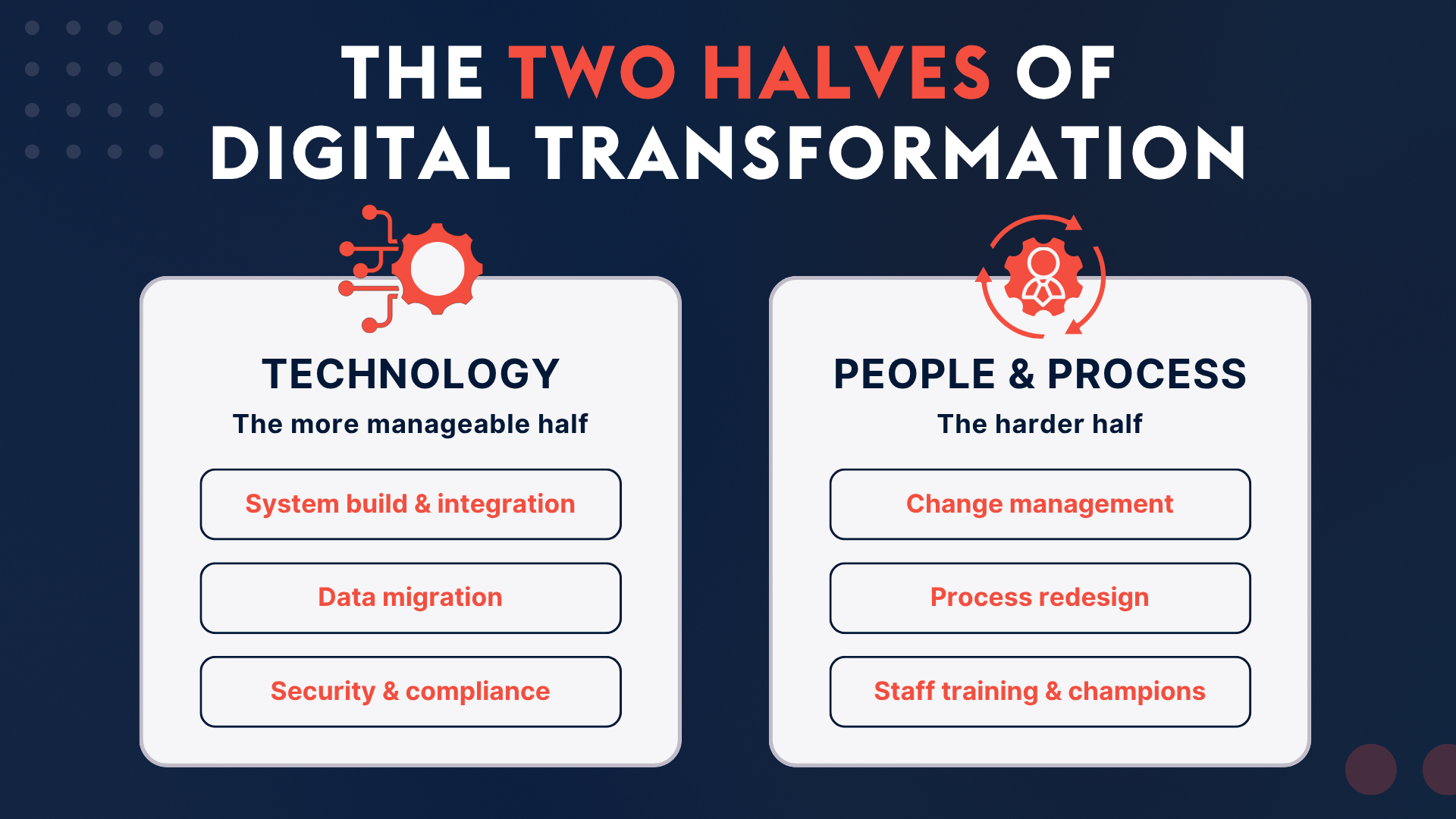
It’s tempting to treat digital transformation as a technical challenge. But technology is only one part of the picture — and once defined and designed, it’s often the more manageable part.
The harder challenges tend to be around people and processes. If you simply drop a new system in without addressing how people work, it won’t deliver the transformation you expected. When we helped deliver the ePlanning portal, for instance, we spent considerable effort aligning processes across 31 councils and training staff on new workflows. Those non-technical elements were critical to the project’s success.
Councils are often surprised by how much internal change is required. Going digital has a way of surfacing old inefficiencies like outdated forms and approval steps that nobody had previously questioned. Once you start mapping these processes, you realise there are opportunities to simplify, but that also means changing long-standing procedures. There’s also the messiness of legacy data: merging years of records or linking systems that haven’t been updated in decades is rarely straightforward, but it’s absolutely critical to get right.
Even the most well-engineered system can fall flat if the people using it aren’t brought along on the journey. In our experience, delivering the technology is roughly half the work. The other half is change management.
Delivering technology without proper change management is a bit like building a road and not putting up any signs or lights. The infrastructure might be there, but it won’t be used to its potential.
In practice, this means training sessions, user guides, open forums, and — perhaps most importantly — change champions. These are the people within an organisation who drive engagement with the new system and provide a point of contact when colleagues need support. It also means communicating the why. Staff need to understand what’s in it for them. Will it save them time? Reduce errors? Give them better data than they had before? Without that context, even a significant improvement can feel like an imposition.
One of the most common assumptions we encounter is: if we build it, they will use it. In reality, that’s not always how it plays out. Some citizens will stick to traditional channels regardless of how good the digital alternative is. Foot traffic at council offices does reduce after services go online, but it’s a slow, gradual process, not an overnight shift.
Another misconception is designing services around existing departmental structures rather than around how citizens actually think and behave. A council might organise its website to reflect internal teams and workflows, assuming citizens know where to click or which process to follow. But from a citizen’s perspective, the journey looks very different.
Take a planning application. A citizen simply wants to gather the information they need, pull it together, and submit. The internal approval workflows, vetting stages, and technical assessments that matter to the planning department are largely invisible to them — and rightly so. The best digital services make that complexity disappear.
There’s an important distinction between a service that’s user-friendly and one that’s truly citizen-centric. A well-designed online form with a clean interface can still force someone through five or six approval steps and multiple in-person visits. That’s user-friendly, but it’s not citizen-centric.
True citizen-centric design rethinks the entire service journey from the citizen’s perspective. It asks not just “is this easy to use?” but “should the citizen even have to do this step at all?” Can a check that previously required a phone call be replaced by a form? Can data already held by the council be pre-filled, rather than asking someone to re-enter the same information multiple times?
For example, rather than asking citizens to navigate multiple departments separately, group everything related to a significant life event into one place. Having a baby, for instance, could bring together medical card registration, birth registration, and child benefit applications into a single, joined-up process, even if those services are managed by different agencies in the background.
Accessibility is also a key part of the picture. Citizen-centric design means designing for everyone, including those with visual impairments and those who aren’t particularly tech-savvy. That means building in the right guidance, support, and help functions so that no one is left behind.
Our work on two major national platforms illustrates what citizen-centric design looks like in practice.
The e-Planning portal replaced a cumbersome paper-based process that required applicants to submit multiple physical copies of documents and, in many cases, travel to their local council office. Today, any applicant can visit a single national website, follow clear steps, upload documents, and pay fees electronically regardless of which county they’re in.
Critically, the portal was built around the applicant’s journey. Plain language, helpful guidance notes, the ability to save progress, and automated email updates at key stages mean applicants are never left wondering what’s happened to their submission. On the council side, GIS integration and streamlined document management made planners’ jobs easier, which ultimately meant faster decisions for citizens. Both sides benefited, which is what makes it work.
The HAP system — the national housing assistance payment platform — took a similar approach. Before centralisation, tenants and landlords in different counties encountered different processes and different systems. The new platform created a single national process, a shared service centre, and a consistent experience regardless of location.
Privacy and data protection were embedded into the system from day one, not bolted on afterwards. Role-based access controls ensure council staff only see data relevant to their own function. Audit trails log who viewed or changed sensitive records. PPS numbers are automatically masked for anyone without authorisation. GDPR compliance was a core design principle, giving both tenants and landlords confidence that their information was being handled with care.
For any council approaching digital transformation — whether just starting out or scaling existing efforts — here are a few principles that consistently make the difference.
Start with the citizen and work backwards. Understand the needs and pain points of the people you’re serving before procuring technology. Don’t try to tackle everything at once; identify high-impact services, digitise those well, and learn from the experience before moving on.
Invest in change management as much as you invest in the technology. Bring staff along, secure executive sponsorship early, and make sure leadership is actively championing the project, especially when things get difficult.
Collaborate and reuse. Many councils face the same challenges, and there’s no need to reinvent the wheel. Shared platforms and national solutions exist for good reason. Use them, and customise where needed.
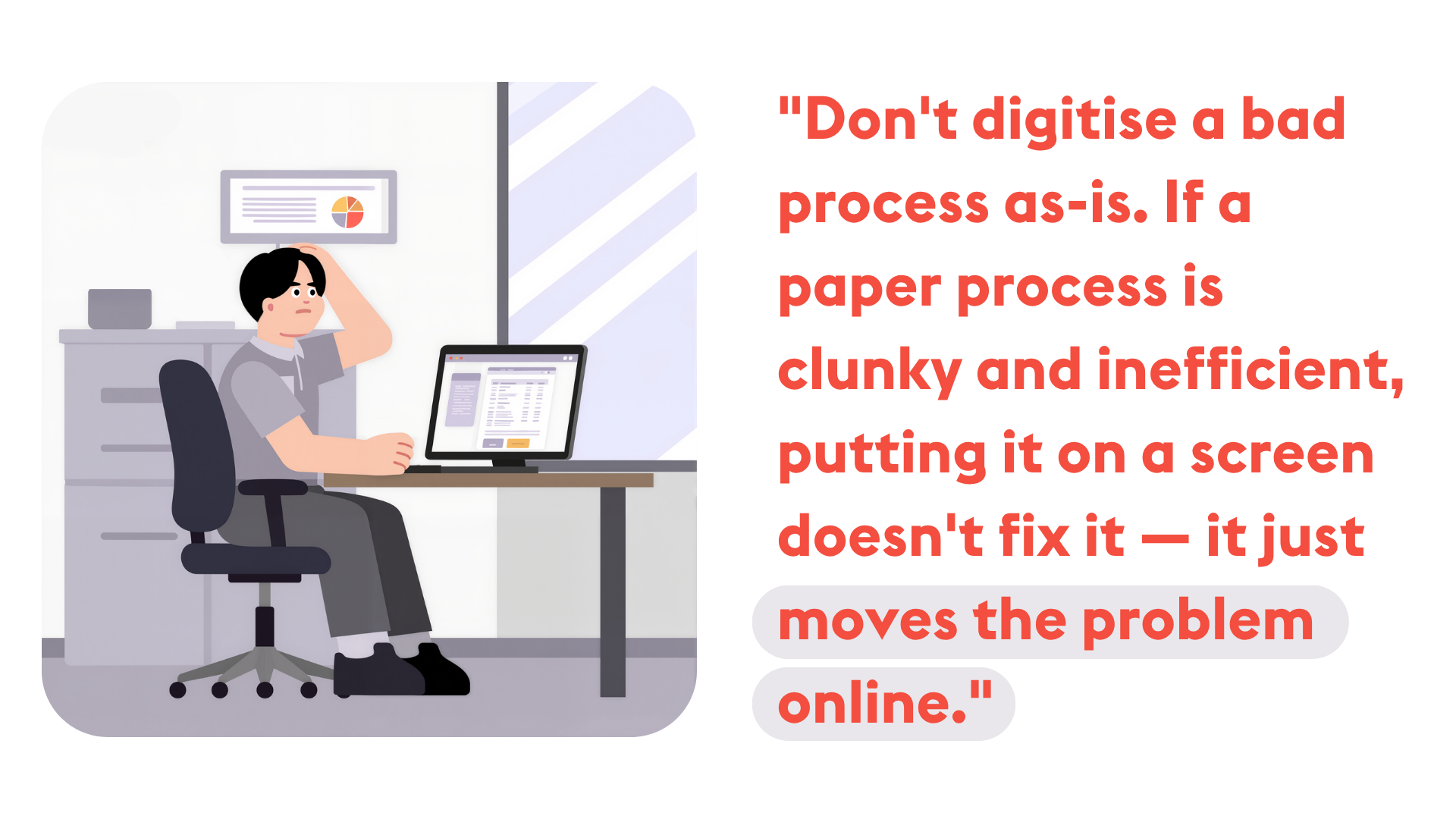
Don’t digitise a bad process as-is. If a paper process is clunky and inefficient, putting it on a screen doesn’t fix it — it just moves the problem online. Use the transformation as an opportunity to simplify, not just automate.
Digital projects are never truly finished. Once a service goes live, citizens provide feedback, expectations evolve, and the system needs to keep pace. Build something that can grow and improve over time.
The ambition behind Ireland’s 2030 digital strategy is the right one. When digital government works well, it feels almost effortless. Citizens accomplish what they need to do without friction, without confusion, and without having to learn a new system every time. It feels less like interacting with a government department and more like completing a simple online transaction.
But getting there requires more than good technology. It requires empathy, careful process design, genuine engagement with end users, and a commitment to ongoing improvement long after launch.
At Provident CRM, we understand the complexity of these projects and the importance of getting them right, both for councils and for the citizens they serve.
If your organisation is embarking on — or looking to accelerate — its digital transformation journey, contact us today to find out how we can help.