
Sales leaders are heading into 2026 with ambitious growth targets, more informed buyers, and a market that’s moving fast. But there’s also a real opportunity this year: teams that combine strong sales fundamentals with the right AI support will build momentum faster, forecast with more confidence, and convert more consistently.
The truth is, AI is now part of the sales landscape — and when used well, it helps revenue teams stay relevant, move quicker, and focus on the opportunities that matter most. The challenge isn’t whether AI belongs in sales. It’s how to use it in a way that creates signal, not noise — especially when buyers are harder to engage, sales cycles are stretching, and decisions that once took weeks can now take months.
That’s why Q1 is such a powerful moment for sales leadership. It’s not just the start of a new quarter — it’s your best window to strengthen the pipeline you already have, improve deal momentum, and set your team up to get real value from AI throughout 2026.
Provident CRM’s Chief Revenue Officer, Gary Cullen, and Senior Sales Executive, Trevor Rogerson, recently sat down to unpack what’s changing in sales as we enter 2026 — and what forward-thinking teams are doing differently to build a pipeline that moves, even in uncertain conditions.
So what should sales leaders prioritise in Q1 to set themselves up for a stronger 2026?
A simple focus with a big impact: pipeline momentum + AI-ready clarity.
AI promised “personalisation at scale”, faster prospecting, and more efficient selling. But in practice, many teams are finding themselves in a stalemate:
That’s the false productivity trap: teams feel productive because dashboards show high output, but pipeline quality and conversion don’t improve.
Where AI does make a difference is when it’s guided by real customer context. When sales teams use AI to understand account history, identify meaningful buying signals, and prioritise the right opportunities, it helps them stand out rather than blending in. Instead of pushing more messages, AI supports better conversations grounded in what the customer has actually done, said, or experienced.
Avoiding the false productivity trap means shifting the role of AI from “doing more” to “doing what matters.”

The start of the year is often when pipelines look healthiest on paper, and that’s exactly why Q1 is your strongest window to reset and lead with clarity.
A large pipeline can feel reassuring, but size alone doesn’t equal security. What really matters is coverage you can trust — a pipeline built to absorb reality: deals slipping, decisions stalling, and opportunities quietly going cold. Without that buffer, forecasting just becomes guesswork.
This is why Trevor emphasised the importance of a proper reset at the start of the year. Q1 isn’t just about setting targets; it’s about pressure-testing whether the pipeline you’re carrying can realistically deliver them.
Sales leaders need to move away from asking “How big is the pipeline?” and start asking:
Pipelines become misleading when deals linger in the same stage month after month, close dates keep getting pushed, or large opportunities mask a lack of consistent deal flow underneath. That’s when a strong-looking forecast quietly becomes a liability.
The most effective sales leaders shift their focus from managing totals to managing movement and quality. They look for flow, not just volume. A smaller pipeline with clear progress, strong qualification, and consistent deal sizes will outperform a bloated one built on hope every time.
Q1 is your window to reassess qualification criteria, tighten stage definitions, and be honest about which deals are genuinely alive. Because any strategy, AI-driven or otherwise, is only as good as the pipeline it’s built on.
Here’s the most practical takeaway, and the one that creates immediate momentum for you in Q1:
1. Next step is agreed (not assumed)
Strong deals move forward through visible buyer commitment — not hopeful follow-ups.
• Is there real scheduled action with the buyer?
• A confirmed meeting, decision review, stakeholder session, or timeline checkpoint?
• Not, “follow up next week”, but a specific meeting, decision point, or agreed activity.
✅ When next steps are clear, your team stays focused — and AI can support better prioritisation, reminders, and momentum tracking.
2. Stage reflects buyer reality (not internal optimism)
In 2026, deals don’t stall because sellers aren’t working hard — they stall because buyers have more stakeholders, tighter budgets, procurement steps, and competing priorities.
• Does the stage match what the buyer has actually done?
• Has this deal genuinely progressed in the last 14–30 days?
• Are we seeing real momentum… or just internal activity?
✅ Clear stage definitions make forecasting more accurate — and allow AI to highlight risk earlier (before the quarter depends on “maybe”).
3. Focus pipeline on what’s most likely to convert
This isn’t about “losing pipeline.” It’s about gaining clarity.
• If there’s no movement, no response, or no evidence of buying intent, is it time to reclassify it?
• Should it move into a nurture track, a later-quarter bucket, or a future opportunity list?
• Are we freeing up time for deals that have real conversion potential?
✅ When the pipeline reflects reality, your team wins twice: better forecasting now, and far better AI outputs later.
Because AI doesn’t replace leadership — it amplifies it. And the teams that win in 2026 will be the ones combining human judgment with the right AI support, built on clean signals and consistent execution.
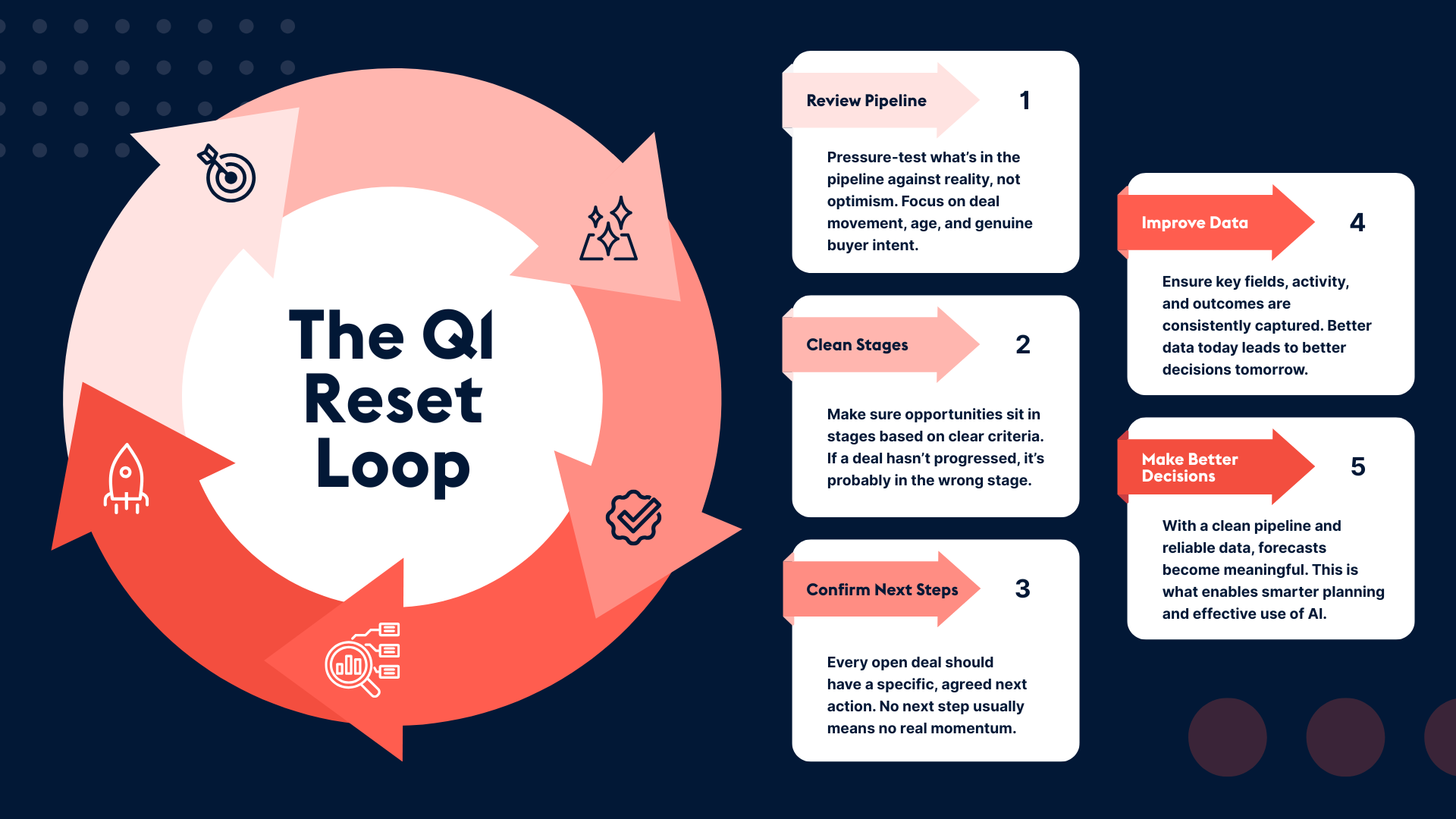
For sales leaders, preparing for AI isn’t about flipping a switch — it’s about creating a pipeline and CRM environment where AI can actually add value. Without clear stages, real next steps, and reliable data, AI simply accelerates existing problems instead of solving them.
In practice, AI-ready sales teams do a few things differently in Q1:
This is where platforms like SugarCRM — including sales-i revenue intelligence and enhanced forecasting — become genuinely useful. When pipeline data is clean and processes are well defined, AI supports better prioritisation, more accurate forecasting, and smarter decision-making without replacing human judgement.
Here, Gary made a blunt but important point: in a market moving this fast, there is no perfectly future-proof plan. Buyer behaviour continues to shift, channels rise and fall, and technology evolves faster than most teams can adapt. What is possible is building a sales engine that can absorb change without breaking.
In 2026, forward-thinking sales leadership is less about chasing the next tactic and more about maintaining momentum across the pipeline. That means moving away from over-reliance on a handful of large, high-risk deals and towards a steady flow of well-qualified opportunities that consistently progress.
Many pipelines fail quietly. They look strong at headline level, but underneath, deals stall in the middle stages, close dates drift, and forecasts depend on optimistic assumptions. Volume masks fragility. Momentum reveals reality.
The strongest teams focus on how deals move, not just how many exist. They pay attention to progression through stages, conversion reliability, and balance across deal sizes. This gives them a pipeline that’s resilient — one that can withstand slips, delays, and inevitable losses without derailing the quarter.
This mindset also shapes how teams adapt. As Gary noted, strategies that didn’t work last year may become effective as buyer behaviour changes, while previously reliable channels may lose impact. Forward-thinking teams iterate continuously, revisit assumptions, and adjust without overcorrecting or blindly chasing trends.
Ultimately, success in 2026 won’t come from predicting the future perfectly. It will come from building a pipeline that keeps moving, even when conditions change.
As sales teams look to get more value from AI, one thing becomes clear very quickly: the technology only works as well as the foundations underneath it. Clean data, clear stages, and real next steps aren’t optional, they’re what determine whether AI supports better decisions or simply accelerates existing problems.
That’s why the work done in Q1 matters. Honest pipeline reviews, disciplined qualification, and consistent data hygiene don’t just improve forecasting in the short term; they create the conditions for AI to be genuinely useful over time.
What we see time and again is that teams don’t need more technology for its own sake. They need space to step back, sense-check their assumptions, and pressure-test whether their pipeline reflects reality or optimism. Often, that clarity comes from an outside perspective — asking the questions that are easy to miss when you’re deep in the day-to-day.
As AI continues to shape how sales teams operate, the organisations that benefit most will be those that treat it as an amplifier of good practice, not a shortcut around it. Strong foundations power AI. AI powers smarter growth.
If any of this resonates and you’d like to talk through how it applies to your own pipeline, processes, or use of AI, we’re always happy to have that conversation.